2024
Hommage Numérique
Hommage Numérique is an experimental short film that draws inspiration from the daring aesthetics of early 20th century avant-garde filmmakers such as Marcel Duchamp, Dudley Murphy, Walter Ruttmann, Viking Eggeling, Len Lye, and especially Hans Richter.
Introduction
Hommage Numérique is an experimental short film that draws inspiration from the daring aesthetics of early 20th-century avant-garde filmmakers such as Marcel Duchamp, Dudley Murphy, Walter Ruttmann, Viking Eggeling, Len Lye, and especially Hans Richter.
These artists developed a cinematographic practice able to incorporate abstract and figurative visual languages, storytelling, symbolism, and conceptual art. While firmly rooted in the Western history and tradition of visual arts, their intellectual and conceptual hubris allowed them to dismiss any potential difference or tension between technological and artistic creativity.
In effect, their blending of technical virtuosity, fearless experimentation, and sustained innovation produced many audiovisual masterpieces, as relevant today as when they premièred.
Hans Richter's Rhythmus 21 (1921), Len Lye's A Colour Box (1935), Walter Ruttmann's Lichtspiel Opus I (1921), and Viking Eggeling's Symphonie diagonale (1924) are examples of the extraordinarily large corpus of abstract masterworks produced between 1920 and 1940.
With footage entirely created using AI, in an era where powerful, usually private, and always obscure tools impose the sadly misnamed "AI aesthetics" brand of artworks, Hommage Numérique hopes to show that technology-infused art remains boundless, subversive, and free.
The inclusion of elements of their iconic cinematographic language aims to pay respectful tribute to the many pioneering artists who created and explored new territories with their cinema.
Their works continue to inspire, move, and amaze us.
Technical description
Hommage Numérique is an abstract short film created entirely by editing AI-generated footage.
To generate these animations, two generative-AI techniques were used: text-to-image generation and Stable Video Diffusion.
Text-to-image transforms a text input—a prompt—into a numerical representation used to condition a generative image model. Several models were employed in this project, mainly Stable Diffusion (open source) and DALL·E (closed source).
Once a still image was generated, another open-source model, Stable Video Diffusion, was used to generate an animation conditioned by the input image. While no textual prompt was used, the model's parameters were heavily adjusted towards purely aesthetic goals.
Due to the computational cost of running Stable Video Diffusion, the animations produced had the extremely low frame rate of seven frames per second.
Using Resolve’s Speed Warp—an AI model that uses optical flow to interpolate between subsequent frames—the resulting AI-generated footage was converted to 30 frames per second.
An abstract narrative
Once all the videos were generated, the film was edited using a non-linear editor. The editing follows a very loose narrative in which the film steadily gains complexity over time.
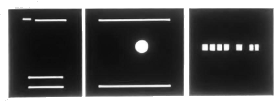
Initially, the takes are flat, two-dimensional, and relatively static. Movement soon appears, followed by the addition of simple, mostly regular, three-dimensional shapes.
This increase in visual complexity reaches a first climax when the whole scene is shown as a coherent whole. A loosely figurative three-dimensional scene appears. Order reigns, and all drawn elements obey the coherence that geometry requires, almost as if recorded by a camera.
This taming of the visual imagery, however, explodes into a geometric disruption taking the form of anthropocentric, surreal-yet-figurative imagery: a staccato of close-ups of faces, with an apparent push-in that relentlessly and somewhat urgently brings them closer.
These faces have many eyes—a reference to Hans Richter’s Filmstudie (1926)—and, not unlike my experience of Richter’s work, suggest the ever-present potential subversion of roles. Art that observes the audience being the artists? A cinephile smorgasbord standing on the broad shoulders of Antheil’s music.
Acknowledgements
All the sounds used in this project were found and are royalty-free:
4k green screen TV: source
24framemedia: source
Editing Elements: source
Most importantly, the music used at the end was taken from the abstract film Ballet Mécanique (1924) by Fernand Léger and Dudley Murphy, with cinematographic input from Man Ray. The film was scored by American avant-garde composer, pianist, author, writer, and inventor George Antheil.
Ballet Mécanique, itself a masterful combination of abstract and figurative forms, was a significant source of inspiration for this work. The film and its historical record are available through MoMA.
- I would also like to thank Cluster.uy, a high-performance computing platform created by Universidad de la República in collaboration with the Uruguayan Government. I was able to use these resources thanks to Prof. Javier Baliosian, Head of the Computer Science Department at Universidad de la República. Prof. Baliosian’s research group kindly covered the computational cost and time required by this project.
Exhibitions
Art Gallery of the 24th IEEE/CVF Conference on Computer Vision and Pattern Recognition, Seattle, WA, US.